original jurisdiction of the supreme court
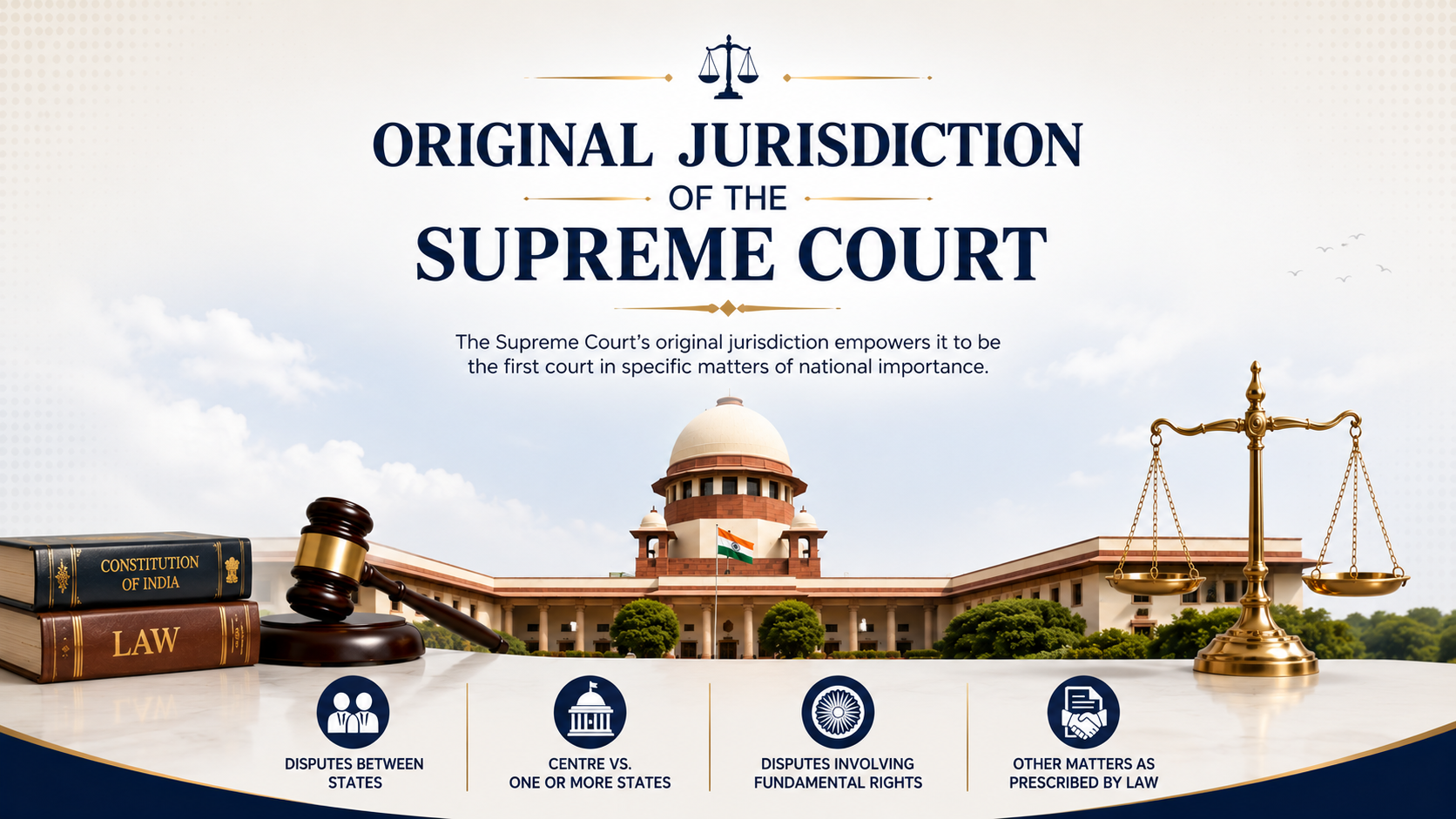
original jurisdiction of the supreme court is one of the most important constitutional powers of India’s highest court because it allows the Court to hear certain disputes directly, without waiting for any lower court decision first. This power mainly comes from Article 131 of Indian Constitution , and it plays a vital role in protecting the balance between the Union and the States.
In simple terms, the Supreme Court uses this jurisdiction when a constitutional dispute arises between governments and the issue involves a legal right. Because of that, types of jurisdiction of Supreme Court must be understood carefully, especially by law students, practitioners, and anyone studying federal relations in India.
What original jurisdiction of the supreme court means
The phrase original jurisdiction of the supreme court refers to the power of the Supreme Court to hear a matter at the first stage itself. In such cases, a party does not go to a lower court first and then appeal upward. Instead, the dispute is filed directly before the Supreme Court because the Constitution gives this forum special authority.
This jurisdiction is not general. It is limited to specific disputes that the Constitution itself identifies. Therefore, the Court does not accept every disagreement between governments under Article 131. The dispute must involve a legal right, and it must be the kind of controversy that the Constitution intends the Supreme Court to decide.
Why this jurisdiction is important
• It creates a direct constitutional forum for major federal disputes.
• It prevents confusion caused by multiple court interpretations.
• It ensures that sensitive Union-State issues receive a final and authoritative ruling.
• It helps maintain constitutional order when government powers overlap.
Article 131 of Indian Constitution
Article 131 of Indian Constitution gives the Supreme Court original jurisdiction in specified disputes involving the Union and the States. The provision applies when the Government of India and one or more States are on opposite sides, or when two or more States have a legal dispute between them.
The key requirement is that the matter must concern a legal right. That means the dispute must be real, justiciable, and capable of judicial determination. A political complaint, administrative irritation, or general disagreement does not automatically qualify for Article 131.
Article 131 covers these disputes
• Between the Government of India and one or more States.
• Between the Government of India and one or more States on one side and one or more other States on the other side.
• Between two or more States, where the issue affects a legal right.
Important limitation
• Some disputes connected to pre-Constitution treaties, covenants, sanads, or similar instruments may be excluded if those instruments continue to operate or specifically prevent Supreme Court jurisdiction.
Types of jurisdiction of Supreme Court
The types of jurisdiction of Supreme Court are wider than just original jurisdiction. The Supreme Court performs several constitutional functions, and each type of jurisdiction serves a different purpose.
1. Original jurisdiction
This allows the Court to hear selected disputes directly. Article 131 is the best-known example, especially for Centre-State and State-State conflicts.
2. Appellate jurisdiction
The Court hears appeals from High Courts and, in appropriate situations, from certain tribunals. This jurisdiction ensures that important legal questions receive final review.
3. Advisory jurisdiction
Under Article 143, the President may seek the Court’s opinion on questions of law or public importance. The Court does not decide a dispute here in the usual sense; instead, it gives legal advice to the executive.
4. Writ jurisdiction
Under Article 32, the Court protects fundamental rights. If a person’s constitutional rights are violated, the Supreme Court can issue writs to provide relief.
5. Review jurisdiction
The Court can review its own judgment in limited cases, usually when an obvious error appears in the record. This power helps correct serious mistakes without disturbing finality in every case.
6. Curative jurisdiction
This is an extraordinary power used only in rare situations to prevent injustice after review is already exhausted. It is one of the most exceptional remedies in Indian constitutional law.
When Article 131 applies in practice
The Supreme Court has explained that Article 131 cannot be used casually. The dispute must be between proper constitutional parties and must involve a legally recognizable right. Courts have repeatedly emphasized that not every disagreement between the Union and a State becomes an Article 131 case.
For example, in State of Karnataka v. Union of India , the Court adopted a relatively broad understanding and said that a dispute may fall within Article 131 when it involves constitutional powers and legal rights of governments. On the other hand, in State of Rajasthan v. Union of India , the Court warned that mere political tension or administrative conflict is not enough.
A practical test for Article 131
• Is the dispute between the Union and a State, or between States?
• Does the issue involve a legal right?
• Is the controversy justiciable?
• Is the matter excluded by any treaty-based proviso?
If the answer to these questions supports the claim, Article 131 may apply.
Limits on original jurisdiction of the supreme court
Although original jurisdiction of the supreme court is powerful, it has clear boundaries. The Constitution does not allow the Court to become a general forum for every policy dispute between governments.
Major limits
• Private parties usually cannot file directly under Article 131.
• Purely political disputes normally do not qualify.
• Disputes lacking a legal right may be rejected.
• Some treaty-related matters fall outside the scope of the provision.
These limits matter because they preserve the Court’s constitutional role. The Supreme Court should resolve federal legal disputes, not every administrative disagreement that arises in governance.
Important judicial developments
The meaning of original jurisdiction of the supreme court has developed through case law over time. Several decisions have helped shape the modern understanding of Article 131.
State of Rajasthan v. Union of India
This case is often cited for the principle that Article 131 is not meant for every dispute with a political element. The Court stressed that the dispute must be legal in nature.
State of Karnataka v. Union of India
This case showed a broader approach. The Court recognized that if a constitutional issue affects the powers of the Union or a State, the matter may fit within Article 131.
State of Madhya Pradesh v. Union of India
This decision suggested a narrower view and indicated that some constitutional challenges may be better suited for other remedies such as writ jurisdiction.
State of Jharkhand v. State of Bihar
This case again emphasized the importance of Article 131 in disputes between States and highlighted the broad language of the Constitution.
Modern challenges
In recent years, States have increasingly used Article 131 in disputes involving central legislation, federal policy, and constitutional boundaries. That trend shows the continuing relevance of this provision in modern Indian constitutional law.
Article 131 and Article 32
People often confuse original jurisdiction of the supreme court with Article 32, but they are different remedies. Both allow direct access to the Supreme Court, yet they serve different purposes.
Article 131
• Used for disputes between governments.
• Focuses on federal and constitutional rights.
• Usually cannot be used by private individuals.
Article 32
• Used to enforce fundamental rights.
• Can be used by citizens and other persons entitled to constitutional protection.
• Protects individual rights against State action.
So, Article 131 protects the federal structure, while Article 32 protects individual liberty and fundamental rights.
Why this topic matters in 2026
In 2026, Article 131 of Indian Constitution remains highly relevant because Centre-State relations continue to shape taxation, administration, regulation, and public policy. Whenever a State believes that a central law or action affects its constitutional position, Article 131 may become an important legal route.
The types of jurisdiction of Supreme Court also matter because they help lawyers choose the correct remedy. A wrong choice of jurisdiction can waste time, increase costs, and delay justice. Therefore, understanding these powers is essential for legal practice and academic study.
Practical significance
• States can directly challenge certain Union actions.
• The Union can directly resolve disputes with States before the Supreme Court.
• Lawyers must test whether the dispute is legal, constitutional, and justiciable.
• Policymakers must respect judicial boundaries while framing laws and regulations.
Frequently asked questions
What is the original jurisdiction of the supreme court ?
It is the power of the Supreme Court to hear specific disputes directly in the first instance, mainly disputes between the Union and the States or between States under Article 131.
Who can use Article 131 of Indian Constitution ?
The Union of India and States can use Article 131 when the dispute concerns a legal right and falls within the constitutional conditions.
What are the types of jurisdiction of Supreme Court ?
The Supreme Court exercises original, appellate, advisory, writ, review, and curative jurisdiction.
Can a private person file a case under Article 131?
Usually no. Article 131 is mainly meant for disputes between governments, not ordinary private disputes.
Does Article 131 apply to every Centre-State dispute?
No. The dispute must involve a legal right and must not fall into excluded or non-justiciable categories.
Disclaimer
This article is for general informational and educational purposes only and does not constitute legal advice.